• Welcome to your new Gnomio site

    Now, you are in control!

    Moodle is an open-source Learning Management System (LMS) that provides educators with the tools and features to create and manage online courses. It allows educators to organize course materials, create quizzes and assignments, host discussion forums, and track student progress. Moodle is highly flexible and can be customized to meet the specific needs of different institutions and learning environments.

    Moodle supports both synchronous and asynchronous learning environments, enabling educators to host live webinars, video conferences, and chat sessions, as well as providing a variety of tools that support self-paced learning, including videos, interactive quizzes, and discussion forums. The platform also integrates with other tools and systems, such as Google Apps and plagiarism detection software, to provide a seamless learning experience.

    Moodle is widely used in educational institutions, including universities, K-12 schools, and corporate training programs. It is well-suited to online and blended learning environments and distance education programs. Additionally, Moodle's accessibility features make it a popular choice for learners with disabilities, ensuring that courses are inclusive and accessible to all learners.

    The Moodle community is an active group of users, developers, and educators who contribute to the platform's development and improvement. The community provides support, resources, and documentation for users, as well as a forum for sharing ideas and best practices. Moodle releases regular updates and improvements, ensuring that the platform remains up-to-date with the latest technologies and best practices.

    Links of interest:

    (You can edit or remove this text)

Available courses

copilot_image_1781523221133.jpegcopilot_image_1781523221133.jpeg

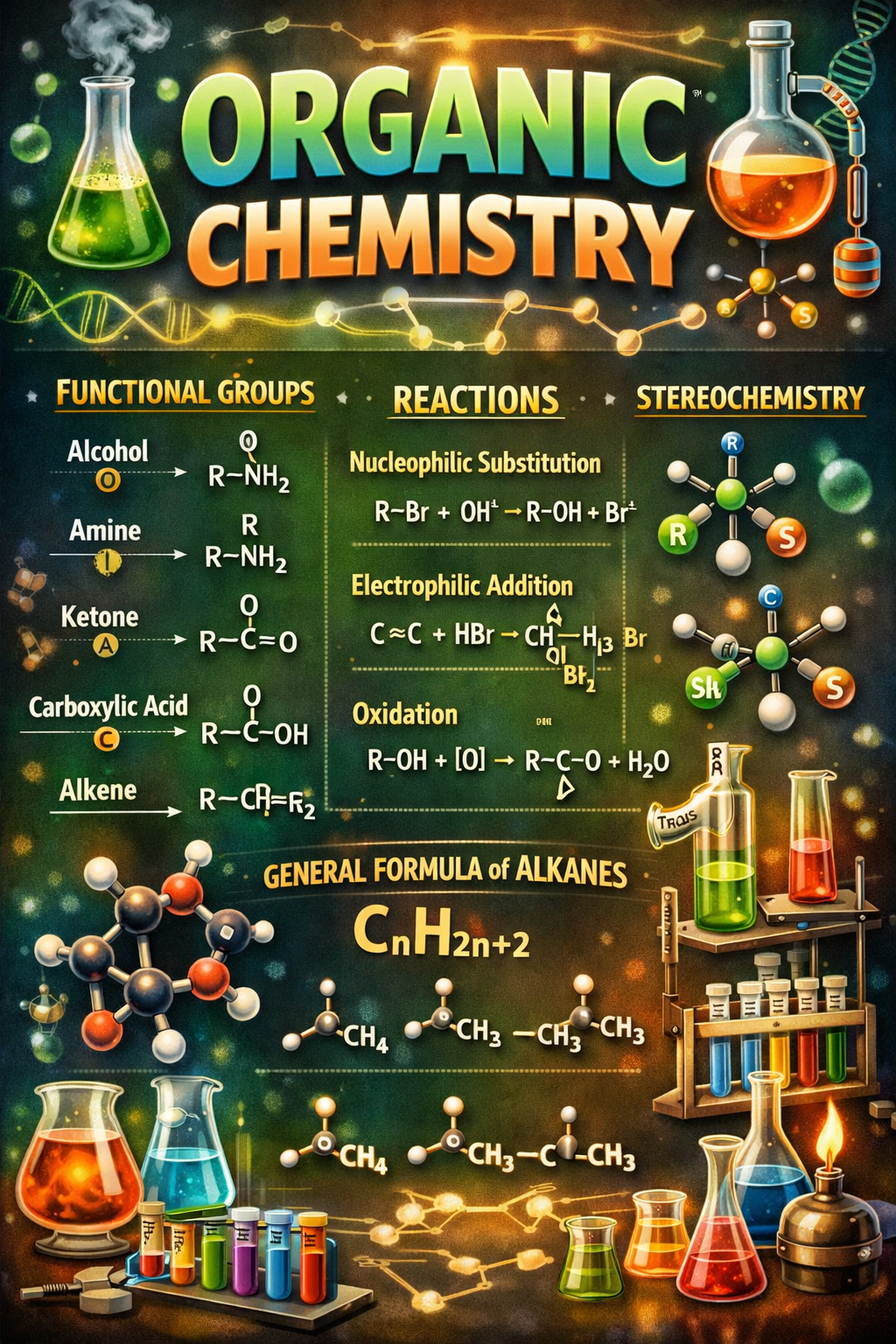
Organic Chemistry is the branch of chemistry that studies the structure, properties, composition, reactions, and synthesis of carbon-containing compounds. The course introduces learners to the fundamental principles governing organic molecules, including hydrocarbons and their derivatives, functional groups, nomenclature, isomerism, reaction mechanisms, and laboratory techniques used in organic synthesis and analysis.

Trainees will explore the relationship between molecular structure and chemical behavior, learn how organic compounds are classified and named according to IUPAC rules, and investigate important reactions of alkanes, alkenes, alkynes, aromatic compounds, alcohols, aldehydes, ketones, carboxylic acids, amines, and other functional groups. The course also highlights the applications of organic chemistry in medicine, agriculture, industry, biotechnology, and everyday life.

Course Learning Outcomes

By the end of the course, trainees should be able to:

Explain the basic concepts and principles of organic chemistry.

Classify and name organic compounds using IUPAC nomenclature.

Describe the structures and properties of major classes of organic compounds.

Explain organic reaction mechanisms and predict reaction products.

Perform basic organic laboratory techniques safely and accurately.

Analyze and interpret organic chemistry data and spectra.

Relate organic chemistry concepts to industrial, environmental, and biological applications.

Course Content

Introduction to Organic Chemistry

Structure and Bonding in Carbon Compounds

IUPAC Nomenclature

Isomerism

Hydrocarbons (Alkanes, Alkenes, Alkynes, Aromatic Compounds)

Functional Groups and Their Reactions

Organic Reaction Mechanisms

Spectroscopy and Structural Determination

Organic Synthesis

Applications of Organic Chemistry in Industry and Biology

Organic Chemistry

Organic Chemistry focuses on the study of carbon-based compounds, their structures, properties, reactions, and applications. The course emphasizes functional groups, stereochemistry, reaction mechanisms, and the use of spectroscopic techniques for structural determination. It also highlights the relevance of organic chemistry in pharmaceuticals, polymers, agriculture, and environmental science.

 Learning Outcomes

By the end of the course, learners will be able to:

- Classify and name organic compounds using IUPAC rules.  

- Explain and predict reaction mechanisms and outcomes for major organic reactions.  

- Apply stereochemical principles to understand molecular behavior and reactivity.  

- Design synthetic routes for simple organic molecules.  

- Interpret spectroscopic data (IR, NMR, MS) to deduce molecular structures.  

- Relate organic chemistry concepts to real-world applications in industry, medicine, and environmental contexts. 

Learning Objectives

To achieve these outcomes, learners will:  

- Understand bonding and hybridization in organic molecules.  

- Identify functional groups and their characteristic reactions.  

- Practice nomenclature for alkanes, alkenes, alkynes, aromatics, and complex molecules.  

- Analyze reaction mechanisms (substitution, elimination, addition, oxidation, reduction).  

- Explore stereochemistry including chirality, optical activity, and conformational analysis.  

- Engage in problem-solving exercises to strengthen synthesis and mechanism skills.  

 Course Summary:

 Inorganic Chemistry

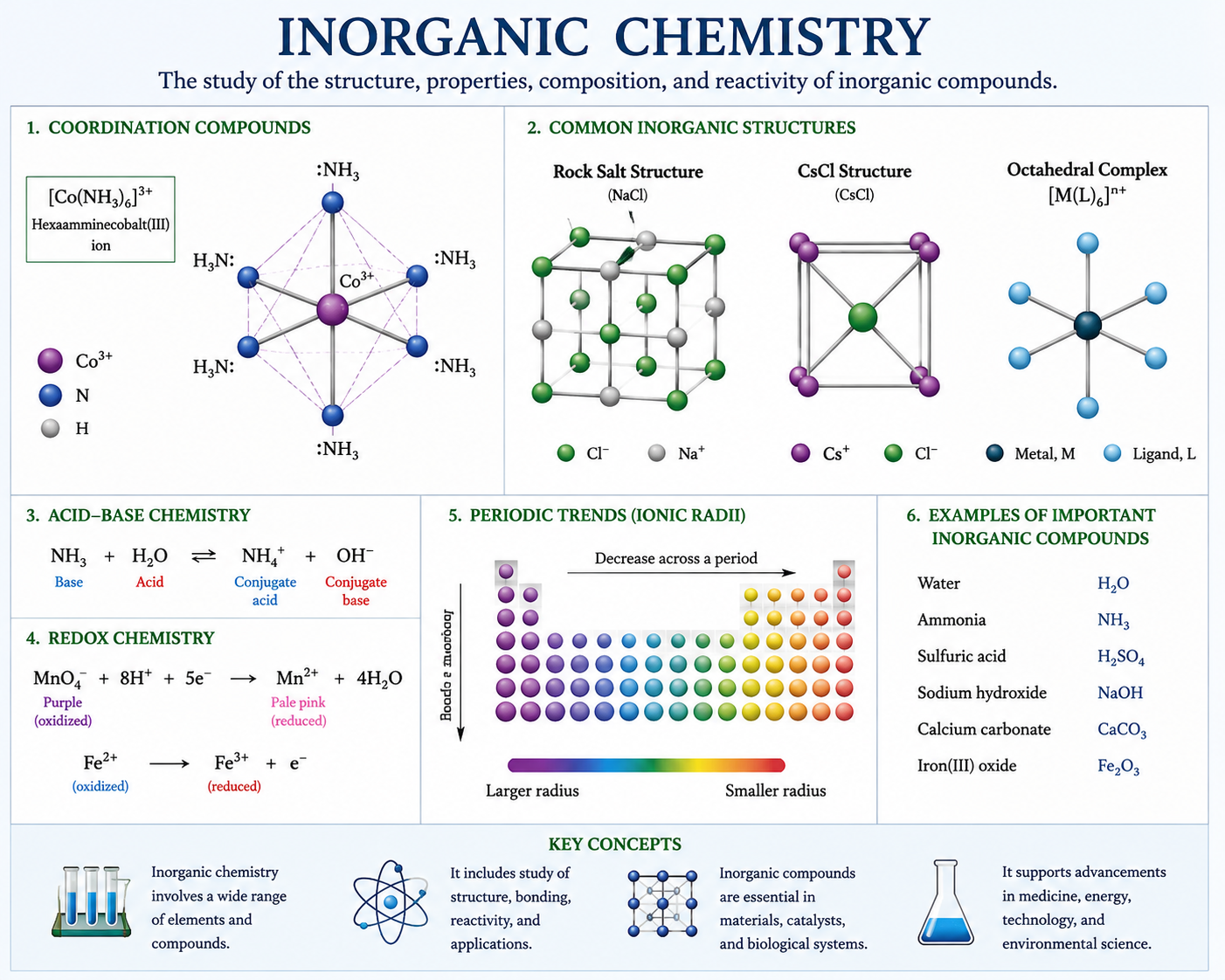
This course introduces the principles, theories, and applications of inorganic chemistry. It explores the structure, bonding, reactivity, and properties of elements and their compounds, with emphasis on periodic trends, coordination chemistry, solid-state chemistry, and the role of inorganic compounds in industry and biological systems. Practical demonstrations and problem-solving exercises reinforce theoretical concepts.

Learning Objectives

By the end of the course, students should be able to:

- Understand the periodic classification of elements and explain periodic trends in atomic and physical properties.  

- Describe the nature of chemical bonding (ionic, covalent, metallic, and coordination).  

- Analyze the structure and reactivity of coordination compounds, including ligand field theory.  

- Explain the chemistry of main group and transition elements, including their oxides, halides, and complexes.  

- Apply inorganic chemistry principles to industrial processes, materials science, and biological systems.  

 Learning Outcomes

After successful completion, students will be able to:

- Classify and predict chemical behavior of elements based on periodic trends.  

- Interpret bonding models and apply them to explain molecular geometry and reactivity.    

- Evaluate the role of inorganic compounds in catalysis, materials, and biological functions.  

- Demonstrate competence in laboratory techniques, including safe handling of chemicals, synthesis, and data interpretation.  

- Communicate chemical concepts effectively, using appropriate terminology, equations, and structural representations. 

Inorganic Chemistry 

Inorganic chemistry is the branch of chemistry that studies elements and compounds other than most carbon-based organic compounds. It focuses on metals, minerals, coordination compounds, acids, bases, salts, and transition elements, including their structures, properties, reactions, and industrial applications.

Learning Outcomes

By the end of the topic, trainees should be able to:

Define inorganic chemistry and explain its scope

Classify elements using the periodic table

Describe properties of metals, non-metals, and metalloids

Explain chemical bonding in inorganic compounds

Apply inorganic chemistry concepts in industry, medicine, and the environment

Possible Learning Activities

Group discussion on the importance of inorganic compounds in daily life

Periodic table analysis and element classification tasks

Solving chemical equations and reaction problems